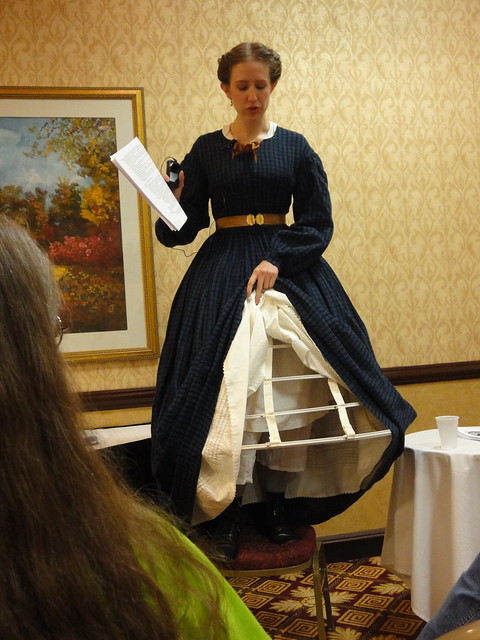
I'm a bit of a diva. I'm an introvert, but if I know what I'm doing (like singing a song, performing a dance, or flying a kite in full 1780s ensemble), I admit I like attention! And usually, posing for pictures when I'm all dolled up in a vintage or historical outfit is the same. But sometimes, I get an an attack of "I don't know what I'm doing!" Suddenly I have no idea how to stand, what to do with my hands, how to position my feet, or do anything else with my body. So I just default to nothing at all.
 |
| Photo by Festive Attyre, who was certainly not to blame for the lack of a pose. |
I've thought about researching how to pose; Stephanie shared some terrific
posing basics recently. But those are general techniques
. What poses did
they do back then? And
which "then" are we talking about? Take Betty Grable's iconic pinup.
That would look really strange in an 1860s hoop skirt! Each period has its own style and its own points of beauty to emphasize.
So mostly for my own education and entertainment, I'm going to make an informal survey of original pictures from different periods to figure out a handful of basic poses for each. Particularly I'm going to focus on full-length, standing-still views that don't rely on large props like furniture, or seated poses without tables or other things. Usually when I take costume pictures I'm without any props except for what I carry, such as in the halls at Costume College. My best opportunities tend to be a tree or two when I'm outside.
First up, I'm starting with the Regency period. The Picnic with the Pixies is Saturday, and I want to be prepared!
* The title line is from the song "Charade," from the 1963 movie of the same name. Music by Henry Mancini, lyrics by Johnny Mercer.
The Classical Ideal: Posing in the Regency Style
Free Standing
I prefer portraits, because they don't tend to suffer from bad drawing or out of proportion figures like fashion plates do. However, full-length free-standing portraits are rare. Anne has the benefit of a romantic seaside backdrop, and a shawl
that is both rippling in the wind and velcro'd to her left elbow. But
the right hand placement is graceful, and her hidden left hand could be
holding a reticule or parasol. Her whole body, and her head, are angled
slightly away from the viewer. One foot is foward.
 |
| Joseph Clover, Anne, Lady Beechey |
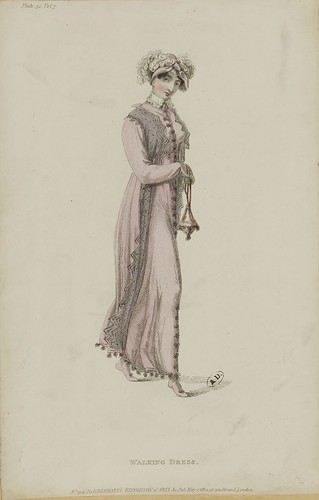
From a fashion plate, but this is just a single example of a very simple and common pose. Face and body straight or barely angled to the viewer with one arm
down by her side holding something (anything - just make sure it's
something) and the other bent at an acute angle, with the hand just
across the centerline of the body. White space is achieved between both
arms and the waist. Feet are in fourth ballet position, with the front
foot pointed.
This can be done with an accessory, like a reticule, in the upper hand, or it can be empty. The hand can also be held
higher,
lower, or
lower still. Just keep the elbow bent and the wrist curved downward. If the hands are any lower, they're usually
together.
 |
| 1814, Costume Parisien. Dress of wool. |
This is very elegant, whether you have an accessory or not. Arms crossed, slightly clasping the wrists. Plenty of white space around the waistline. Body facing the viewer, face and gaze tilted away and slightly down. Feet in fourth ballet position.
Here's a variation with the hands lower down, but elbows still strongly angled.
 |
| 1815 |
I like this variation - the pensive look! It's rather sweet. One hand holding the other elbow, fingers on the side of the face. Facing the viewer, head tilted toward the hand. Feet in a loose third, pointed.
 |
| 1810, Costume Parisien. Velvet hat, trimmed with plush-marten. Velvet jacket. |
Here, angle the body slightly away, and
turn the head slightly back to the viewer. The
active hand is shading the eyes or touching up the curls,
and the feet are in third ballet position with the angled
foot directly toward the viewer.
Here is another plate where the figure is touching her headdress. It may feel awkward (or silly!) to us, but it's a period pose.
 |
| 1816, Costume Parisien. Satin spencer, dress of crepe. |
The lady in a tam is in a surprisingly modern pose. Is her hand
really on her hip? She looks very jaunty, and with her hand hidden by
her plaid, she's not emphasizing an unfashionable waistline. Body angled
away from the viewer, head turned slightly toward, one hand on a chair
back (or a wall, or a table, or a fence, &c.), left foot forward
with supporting leg bent. I'm not sure that last part is physically
sustainable. Just don't stand straight with your feet together!
 |
| March 1814. Opera Dress. La Belle Assemblée. |
This is somewhat unusual, but it's so striking I'm including it. The
subject is an older lady, wearing an old-fashioned cap with a fashionable dress. The pose is completely side-on, arms gracefully bent
and hands holding a posey in front of her. Note also that she is in
motion, or posed that way, with one foot in front of the other.
 |
| Woman in a Blue dress, Jacob Maentel, ca. 1810; Winterthur 1957.1121 A |
Free Standing, Back View
This is excellent for
showing off the back of the dress. Whole body is slightly angled, upper
body slightly more away, and head approaching profile-view. Arms are
slightly bent and slightly to the front, preserving white space between
the body. The foot closest to the viewer is peeking out from under the
dress. Get in this pose as if standing at an angle, then take the left
foot and step away into fourth ballet position, shifting weight forward
and keeping the toe of the right on the ground. That should drape the
skirt nicely.
 |
| 1811, Costume Parisien. Hat of satin and crepe; dress of merino wool. |
Here is an unusual back view portrait, unfortunately not full length. The
girl's body is angled not completely back to the viewer. Her upper body
is slightly twisted toward the front, while her head is straight over
her right shoulder and her eyes meet the viewer's. Her back arm is down
and slightly bent, while her active arm is angled so her elbow is above
her waist. Her fingers and thumb make an "O," with fingers together,
just touching her cheek. Again, white space is preserved around her
waist, even with the draping of the shawl.
 |
| Ekaterina Vasilevna Saltykova, c. 1800 |
Leaning
Okay, I said I didn't want poses that relied on a prop. But Felicte's
pose is a favorite in portraits and fashion plates alike, and very Classically-inspired. She is leaning
slightly to the left, probably with her hip supported by the fence or
gate. The fence is just high enough to support her left elbow at a
slight angle away from her body. Her arm and hand come forward and
across her body. Her left leg crosses her right casually, feet fairly
close together and toes angled slightly toward each other. As with Lady
Beechy, her non-active arm and hand hangs at her side, in this case
holding both a bouquet and her shawl. Her head is tilted back slightly
to the right, opposite from how she's leaning.
 |
| Felicite de Durfort von Merry-Joseph Blondel, 1808 |
This pose can be replicated against a vertical
surface like a fence, tree, boulder, interior wall, or even a doorframe.
The figure's feet are at least a foot away from the support, forcing
her to lean back into it. The surface and her body are both angled
significantly away to the viewer's left. Her arms are slightly bent,
hands holding a book; a fan could be used similarly. As with Felicite,
her left foot is crossed over the right, this time barely resting on the
ground, almost in fifth ballet position. Her face is angled (too much -
bad drawing) back to the viewer's right; either like this, or straight
at the camera, would be effective.
 |
| 1803, Costume Parisien. Hat of Organdie, Piquéé. |
Seated
Part of the Regency aesthetic seems to have been the graceful,
relaxed curve of classic art. This is directly in opposition to the
super-straight-backed look of the 18th century; however, it is
definitely not a modern comfortable slouch.
*
This lady is seated in a "modern" (Regency) chair with a slightly tilted
back. She is seated all the way back in it, gracefully reclining her
upper body. So she isn't sitting ramrod straight, but her belly (if she
had one!) isn't sagging. Also her shoulders are still down, not rounded
or slumped forward in a modern slouch. (Even in
this portrait, the shoulders do not round forward.) Her head is tilted slightly forward.
*
Her hands and forearms are slightly crossed, not quite to her elbows;
they're not tucked into each other in the modern style. This keeps that
all-important "white space" around her waist. Also, her arms are
positioned below her high waistline, but not resting on her belly or her
lap.
* Her legs are extended forward, slightly bent at the knee,
and crossed just at the ankle. Again, the foot toward the viewer is
crossed over. One foot is flat on the ground, the other pointed. This
can be a very comfortable pose.
 |
| 1818 |
Here's a different seated pose, good for backless seats.
*
Kitty is seated at an angle to the viewer, but leaning slightly forward
and twisting toward the viewer, looking back to her left. Her long
necklace or necklace can drape naturally. Her arms are resting in her
lap, one with plenty of white space from the gown. The other covers her
side, but her bare arm does not visually merge into her gown.
*
Her legs and feet in particular are the key here. The back knee is bent
at right angles. The front leg is extended more like in the previous
portrait, with her foot showing. This is another comfortable Regency
pose that is easy to hold. Note that her knees are apart, although it's
not emphasized as in
some fashion plates.
Try to avoid a knees-together pose for Regency; most of the time it
looks stiff and prim, opposite of the graceful, relaxed look desirable
for the period.
 |
| Portrait of Kitty Packe, by Sir Henry William Beechey (1753-1839) |
A seated pose in a short, nearly straight-back chair. It is
nearly straight - her upper body does angle slightly back.
*
The back arm is over the back of the chair, angling her body slightly;
she holds a fan, but a posey or a handkerchief or a card would work as
well. Note the white space between her arm and her waist. Her other arm
covers her waist, but like Kitty's, it is bare and doesn't blend. It is
slightly bent, with her wrist bent more and holding a handkerchief.
* Her legs are crossed at the knee! Again, very modern to us, but very common in period
illustrations. The near leg is the one that's on top.
 |
| September 1813, Evening Dress. La Bell Assemblée. |
Here, the Princess is seated, with lower back and tummy straight. I'd have to practice getting that
graceful upper body forward curve without actually slouching or rolling
my shoulders in! Her arms are together in her lap, palms upward,
fingers relaxed. Her feet aren't visible, but her legs aren't crossed; her ankles might be.
 |
| Princess V. S. Dolgorukaya, Henri Francois Riesener |
One more seated picture. Again, legs crossed at the knee; also the hands
are together in the lap, this time palms down, hand on wrist. She is
sitting like the Princess, but with her head forward and tilted to the
side.
 |
| September 1814, "Sea Side Morning Dress and Bathing Preserver [?]," La Bell Assemblée. |
General Guidelines
If you can't remember any one particular pose, but someone points a camera at you, what do you do?
* Angle your body away from the camera.
* Turn your head back toward the camera.
* One hand up and one hand down, or clasp them together.
* Hands and fingers curved, palms downward.
* If standing, feet in third, fourth, or fifth position.
* If sitting, cross your ankles or your knees, with camera-side foot on top.
* White space around the waist!
One thing I left out of this analysis was trained gowns. There are a surprising number of illustrations of gowns with trains, and how Regency-period women draped them, carried them, and even pinned them. Sometimes they look strange to us, particularly in fashion plates drawn with less skill; but there's some interesting, helpful things there. At least to anyone who wears a trained Regency gown. Would anyone be interested in such an analysis?